Health and Safety Policy — Commercial Waste Regents Park
This document sets out the health and safety policy for the management of commercial waste operations serving Regents Park and surrounding service areas. It is written for organisations that provide rubbish collection and commercial refuse services and for their staff, subcontractors and partners. The policy explains responsibilities, risk controls, and procedures designed to reduce injury, prevent property damage and ensure compliant handling of commercial waste in the workplace and at customer sites.Policy statement and objectives
Our primary objective is to maintain a safe working environment for employees, visitors and the public while delivering efficient commercial waste collection in Regents Park. We commit to:- Comply with applicable health and safety standards and industry best practice;
- Minimise risks associated with commercial rubbish handling, vehicle movements and site operations;
- Provide appropriate training, equipment and supervision to staff;
- Continuously improve safety performance through monitoring and review.
Scope and service area focus
This policy applies to all activities related to commercial waste and rubbish removal services delivered to businesses in and around Regents Park. It covers waste collection, container handling, transfer operations, vehicle loading and unloading, sorting areas, hazardous material segregation, and customer site work. All employees and contractors must follow the controls and reporting processes detailed below.Responsibilities
Management responsibilities include ensuring that safety arrangements are implemented, that staff receive induction and refresher training, and that safe systems of work exist for each task. Supervisors must assess risks, issue protective equipment and stop unsafe work. Employees must follow procedures, report hazards and use PPE correctly. Subcontractors engaged for commercial rubbish services must meet the same safety standards and demonstrate competence.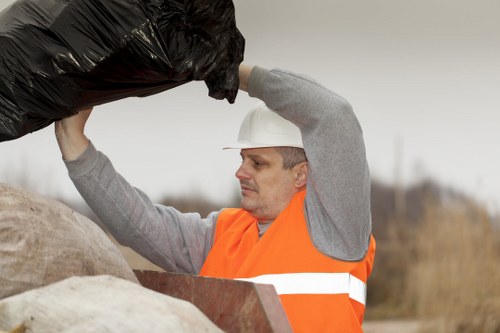
Risk assessment and control measures
All routine tasks shall have documented risk assessments that identify hazards such as manual handling injuries, vehicle collisions, slips and trips, exposure to sharps or hazardous substances, and biological contamination. Controls include:- Mechanical aids and correct lifting techniques to reduce manual handling incidents.
- Traffic management plans, reversing alarms and high-visibility clothing to control vehicle risks.
- Segregation and secure containment of hazardous waste or sharp items; use of labelled containers for different waste streams.
- Regular cleaning and spill response protocols to prevent slips and cross-contamination.
Personal protective equipment (PPE) and uniforms
Staff must be provided with appropriate PPE for their duties, including gloves, safety boots, high-visibility apparel, eye protection and respiratory protection where required. PPE is a last line of defence and must be used together with engineering and administrative controls. Supervisors will monitor compliance and replace damaged or worn equipment promptly. PPE use is mandatory for any task that has residual risk after controls are applied.Training, competence and induction
All workers involved in commercial waste operations shall complete a site-specific induction and receive training in safe handling, manual handling, segregation, vehicle operations and emergency procedures. Training will be documented, refreshed at intervals and updated when processes change. Contractors must provide evidence of training and competency before commencing work on rubbish collection and refuse management projects.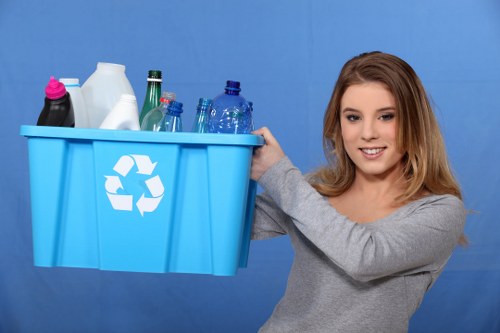
Vehicle safety and on-road conduct
Company vehicles used for rubbish collection in Regents Park commercial service areas must be maintained to a safe standard, with daily walk-round checks recorded. Drivers shall adhere to road safety legislation and company rules for load security, speed limits and parking. Reversing should be avoided where possible; when necessary, use a banksman or guidance systems. Vehicle safety is central to preventing serious incidents during commercial waste collections.
Hazardous waste and contamination control
The policy requires clear procedures for identifying and segregating hazardous and controlled wastes. Staff must not accept unknown hazardous materials without authorisation and suitable containment. Spill kits, neutralising agents and waste containment equipment must be available at transfer points. When hazardous waste is identified, the site will be secured and specialist removal arranged in line with regulatory expectations and safe disposal chains.Incident reporting, investigation and emergency response
All incidents, near misses and upward trends in minor injuries must be reported immediately and recorded. Investigations will identify root causes and corrective actions. Emergency procedures must be visible at operational sites and cover scenarios such as vehicle collisions, chemical spills, fire, and severe injury. First aid provision, trained responders and communication protocols will be maintained to ensure a prompt response.Monitoring, audit and continuous improvement
Performance will be measured using safety indicators such as incident frequency, training completions, vehicle checks and audit outcomes. Regular inspections and third-party audits will verify compliance with the health and safety requirements for commercial refuse and rubbish services. Findings will be acted upon to reduce risk, and policy updates will be communicated across teams.Policy review and commitment
This policy will be reviewed annually and when significant changes occur to operations or legislation. Senior management will endorse the policy and support the resources necessary to achieve its aims. By following these arrangements, the organisation commits to delivering safe, reliable and responsible commercial waste services across the Regents Park service area while protecting people and the environment.
